Trauma & healing
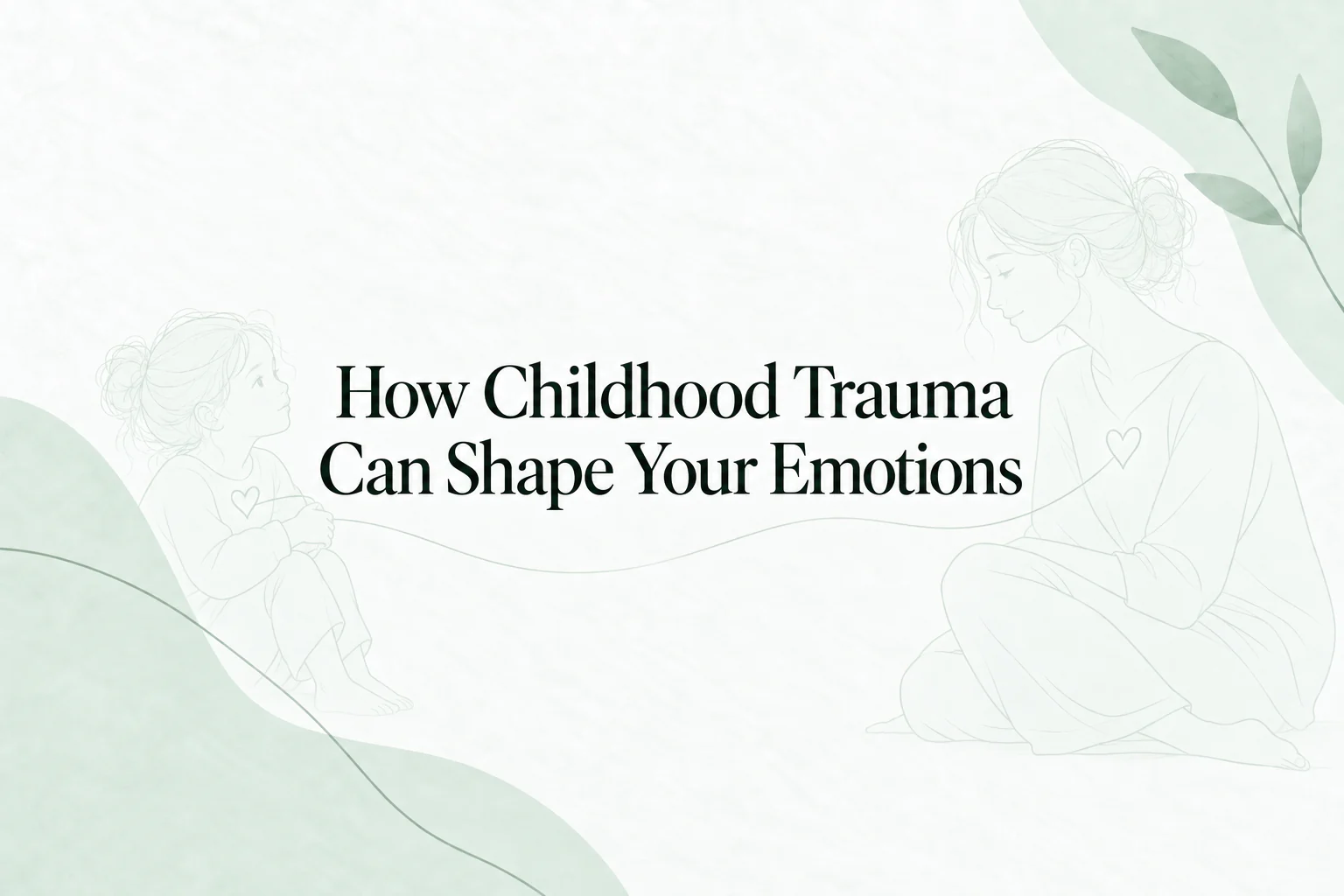
How Childhood Trauma Shapes Your Emotions as an Adult
I once asked a client what she was feeling in a session, and she genuinely paused for a long time before saying, "I don't know. I haven't checked in a while."
She wasn't being difficult. She had spent so many years pushing her emotions down that she had simply lost the ability to notice them. That moment stayed with me, because it captures something important about what happens to the emotional world of someone who grew up without enough safety or support.
Emotions are supposed to work like warning lights on a dashboard. Fear tells you something is wrong so you can move toward help. Sadness tells you something was lost so you can grieve it and move on. In a safe childhood, a child learns this because someone is there to help them make sense of what they're feeling. But when reaching out for comfort gets met with rejection, punishment, or silence instead, something in the brain quietly rewires itself. Feeling starts to seem dangerous rather than useful, and a whole set of coping patterns begins to form around avoiding it.
Pushing feelings down until they disappear
One of the most common patterns is simply shutting emotions off. At first it feels effective. If you can't fix the pain, why feel it. Over time, people get so good at this that they stop noticing their own emotions altogether, almost like holding a beach ball underwater for so long that you forget it's even there.
The problem is that this doesn't actually make the feelings go away. They keep running quietly in the background, still shaping decisions and reactions, just without your awareness. And the cost shows up in relationships too. People sense the distance. They say things like I can't get close to you, and it's often true, because it's hard to let someone in when you've spent years training yourself not to feel much of anything at all.
Going from calm to overwhelmed in seconds
Another pattern shows up as emotional swings that seem to come out of nowhere. One moment everything is fine, and the next there's a full blown reaction to something small. This usually isn't about the moment itself.
As children, we're not born knowing how to calm ourselves down. We learn it by borrowing calm from a steady, safe adult, again and again, until our own nervous system picks up the pattern. Without that, there's no internal template for settling down once something upsetting happens, so the switch from calm to overwhelmed can feel instant and uncontrollable. The good news is that the body can still learn this later in life, often more through rhythm and movement, like walking, breathing, or music, than through simply thinking your way calm.
When feelings get mistaken for facts
There's also a pattern where emotions start to feel like proof. If something feels like rejection, it must be rejection. If it feels like nobody cares, then nobody must care. This kind of reasoning comes from the more primitive, feeling based part of the brain rather than the part that can weigh evidence and context.
It's an honest mistake, not a character flaw, but it can quietly damage relationships, especially when someone reacts to a perceived hurt that was never actually intended. Learning to pause and ask, is this a fact or is this a feeling, becomes one of the more powerful tools in untangling this pattern.

Anxiety, low mood, and a body that's tired of running
For many people who grew up this way, anxiety and a heavy, low mood become the background noise of daily life. Constant stress in childhood keeps the body stuck in high alert, and eventually that catches up. Sometimes depression isn't just sadness. It can be the body's own attempt to force some rest after years without it.
None of this means something is permanently broken. It usually means the nervous system adapted to a world that wasn't safe enough, and it's still waiting for a signal that it can finally stand down.
Wanting to hope, and being afraid to
Perhaps the most tender pattern of all is what happens to hope. As children, most of us hoped endlessly that if we just tried a little differently, things would get better. When that hope kept getting disappointed, something eventually shifted, and hoping itself started to feel like the real danger.
Not because hope is bad, but because being let down again felt unbearable. So many people carry that quietly into adulthood, wanting things to get better but bracing themselves against actually believing it could happen.
None of this means something is wrong with you
If any of this feels familiar, I want you to know none of it means something is wrong with you. It means your emotional world adapted, as best it could, to circumstances that asked far too much of a child. And adaptations, even the painful ones, can be gently unlearned with enough safety, patience, and support.